- Wipe
- Rinse
- Dry
How to remove limescale from taps, showers and toilets
How to dissolve limescale on taps, showerheads, screens and toilets with the acid each can take, what acids damage, and why descaler never meets bleach.
Limescale dissolves in a mild acid such as citric acid or white vinegar, but taps and showers come first from their maker’s care instructions: Hansgrohe and Grohe both advise against vinegar on their finishes. Give each surface only the acid it can take, for as long as the label says, rinse it off, and never use a descaler with bleach, because together they give off chlorine gas.
Limescale dissolves in a mild acid, so the quick fix is the right acid for each surface, left on long enough to work, then rinsed off. Citric acid or white vinegar shifts it from shower screens and toilets. Taps and showers start from their maker’s care instructions, because makers such as Hansgrohe and Grohe advise against vinegar on their finishes. And since almost every limescale remover is an acid, none of them is ever used with bleach.
What limescale is, and what dissolves it
Hard water carries dissolved calcium and magnesium, as the Drinking Water Inspectorate’s guide to water hardness explains. When the water dries or is heated, it leaves them behind as limescale: the crust around a tap, the spots on a screen, the tide marks on basins, baths and toilets.
Limescale is mostly calcium carbonate, which acids dissolve:
- Citric acid: a powder to dissolve in water, and the active ingredient in many mild bathroom cleaners, with no smell. Hansgrohe recommends a mild citric acid cleaner for its taps.
- White vinegar: acetic acid, slower and smellier; some tap and shower makers rule it out.
- Lactic acid: found with citric acid in some bleach-free toilet cleaners.
- Stronger acids in some heavy-duty descalers, such as hydrochloric, phosphoric or formic acid: quicker, harder on finishes, and all three on Hansgrohe’s list to keep off its taps.
Bicarbonate of soda and bleach don’t dissolve limescale at all, and Hansgrohe advises against both on its taps. The bathroom and limescale shelf in our Cupboard has citric acid, a limescale spray and a bleach-free toilet cleaner.
| Surface | What to use | How long | Never |
|---|---|---|---|
| Taps | What the maker says: a mild citric acid cleaner on a cloth, or soap | Wipe on, rinse off | Vinegar, scourers or a descaler it rules out |
| Showerheads | Rub the nozzles, then a mild citric acid soak | A few minutes | Spraying cleaner straight onto the shower |
| Shower screens | Diluted white vinegar or citric acid | A few minutes | Letting it run onto stone or the valve |
| Toilets | An acid toilet descaler, or citric acid | As long as the label says | Bleach before, with or after it |
Taps: the maker’s care instructions first
The usual advice, wrapping a tap in a vinegar-soaked cloth, ignores what tap makers say. Hansgrohe’s guide to descaling taps recommends a mild, citric-acid-based cleaner, sprayed onto a soft cloth and never onto the tap, and advises against vinegar-based cleaners, bicarbonate of soda, scouring agents, metal sponges and microfibre cloths. Grohe’s care instructions are stricter: a little soap and a damp cloth only, no acids, limescale removers or household vinegar, and its own GrohClean for limescale. Grohe adds that damage from the wrong treatment isn’t covered by its warranty.
So find out who made your tap, from the name on it or its leaflet, and read their care instructions. Where the maker allows a mild acid, as Hansgrohe does:
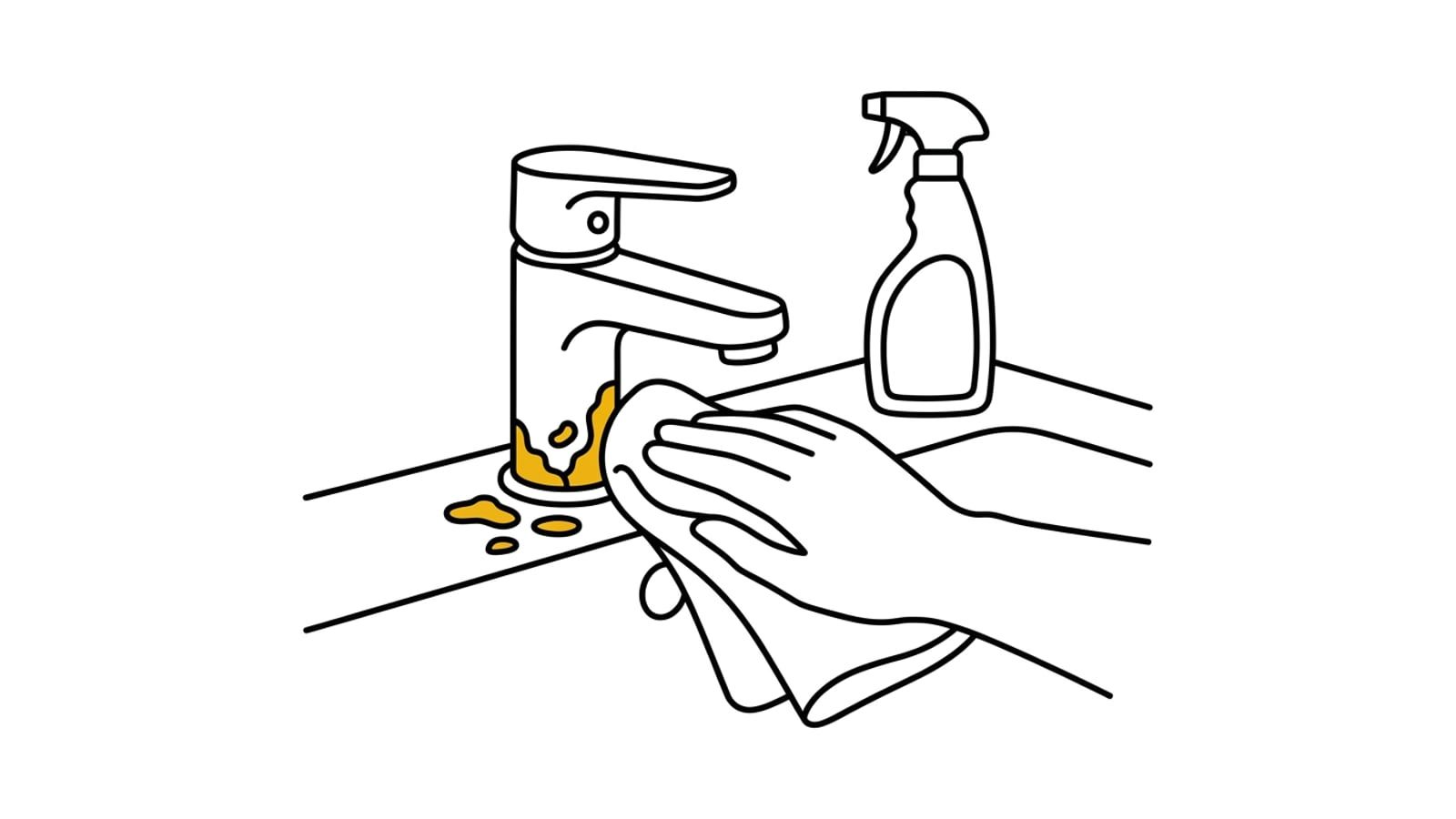
- Spray a mild citric acid cleaner onto a soft cotton cloth, not onto the tap.
- Wipe the scale away, working into the corners and grooves where it collects.
- Rinse the tap thoroughly with clean water, so no cleaner is left on the finish.
- Dry it with a soft, dry cloth.
Where the maker says soap only, as Grohe does, use soap and a damp cloth, and the maker’s own product on the scale. If you can’t find out who made the tap, start with soap and water, then a mild citric acid cleaner on the cloth for any scale left, patch tested on the back of the tap first and rinsed off at once. Find the maker’s instructions before putting any acid on a brushed, coloured or matt finish.
The aerator
The aerator, the mesh insert at the end of the spout, is where scale slows the flow. Hansgrohe says to unscrew it and soak it for about ten minutes in hot water with a little cleaning agent, then screw it back on and run the tap briefly. Some need the small key that came with the tap.
Showerheads
Many showerheads have flexible silicone nozzles, such as Hansgrohe’s QuickClean and Grohe’s SpeedClean, that shed light scale when rubbed with a finger. For heavier scale, follow your shower’s instructions. Hansgrohe’s, for its hand showers:
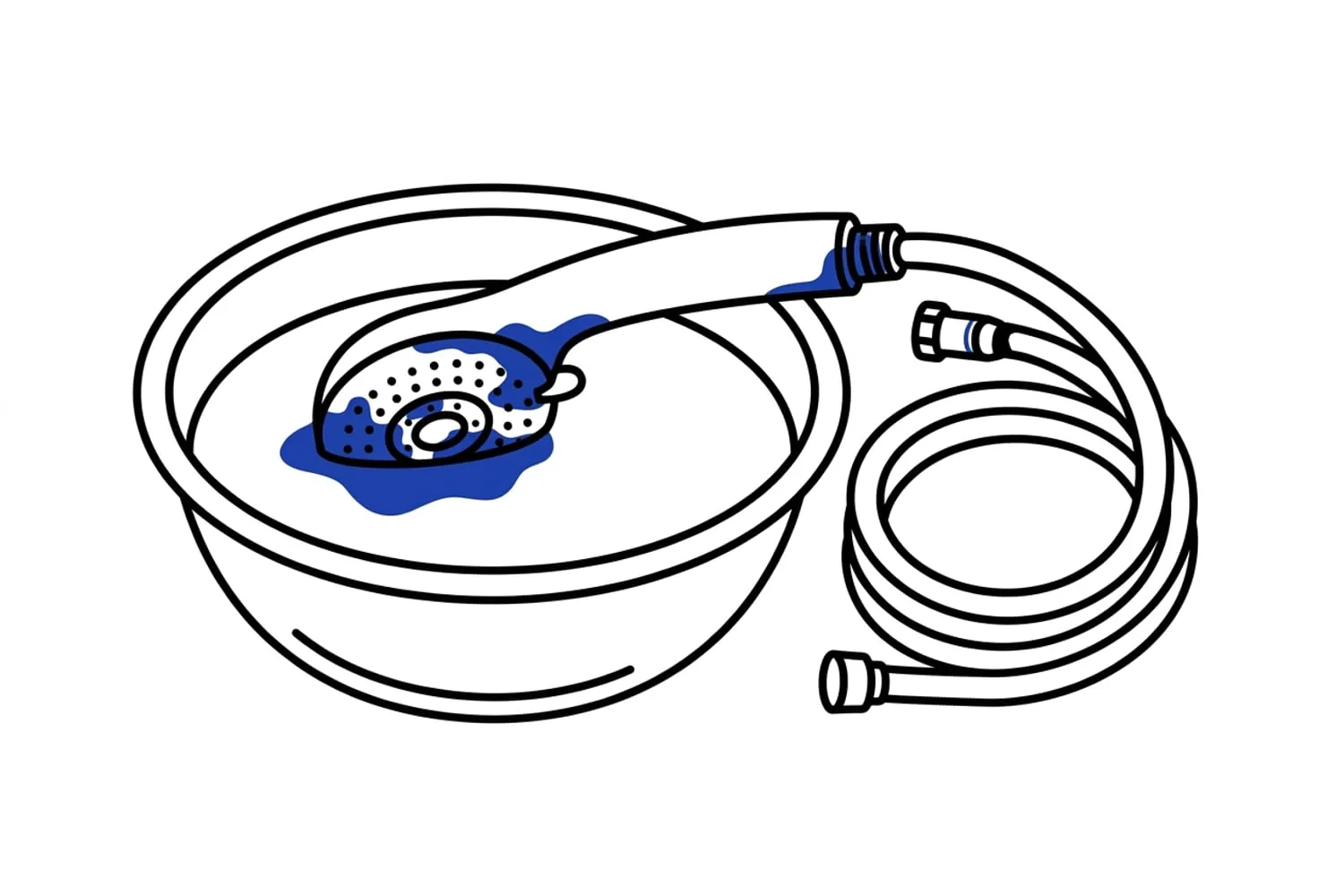
- Unscrew the hand shower from the hose and take out the filter screen in the connection.
- Put the head in a bowl of mild citric-acid-based cleaner for a few minutes.
- Rinse it inside and out with clean water, refit the filter screen and screw the head back on.
- Run the shower through every spray setting to clear out any cleaner.
Hansgrohe says never to spray cleaner straight onto a shower, because the mist can get inside and do damage. It also rules out steam cleaners, scourers, microfibre cloths and cleaners containing acetic acid, the acid in vinegar, so skip the bag of vinegar tied over a fixed head unless your shower’s maker allows it.
Shower screens and glass
Glass takes a mild acid well; keep the spray off the shower valve, the head and any stone.
- Mix white vinegar half and half with warm water in a spray bottle, or dissolve citric acid in water as its maker directs.
- Spray the glass, leave it for a few minutes, and spray again if it starts to dry.
- Wipe with a non-scratch sponge, from the top down.
- Rinse with clean water, then squeegee or dry with a soft cloth.
Rinse acid off the seals, grout and frame rather than leaving it to sit. If the screen has a factory coating that sheds water, check its maker’s care instructions first.
Toilets: under the rim and at the waterline
Limescale builds up in a ring at the waterline and under the rim, where it can block the holes the flush comes through. Wear rubber gloves, and check first that nothing in the toilet contains bleach (see below).
- Lower the water level by pushing the toilet brush firmly into the outlet a few times, so the descaler sits on the ring rather than in the water.
- Squirt an acid toilet descaler all the way round under the rim and onto the ring.
- Leave it as long as the label says; some bleach-free cleaners are made to sit overnight.
- Scrub with the toilet brush, under the rim as well, and flush.
- Repeat on the following nights while the ring is still shrinking.
Citric acid powder works too: Fill’s directions are two tablespoons in the bowl with warm water, left for an hour, then flushed. Use warm water, never boiling, which can crack the pan. Don’t attack thick scale with a metal scraper, wire wool or a scourer, which scratch the glaze, and ask a plumber about scale that won’t shift after several rounds.
Brown marks are usually limescale stained by minerals in the water. A streak running down from under the rim often means the cistern is letting a trickle through, so get the leak fixed or the mark comes back. Rust from a can or a metal shelf is a different stain: the Stain Finder’s rust method covers glazed ceramic.
Surfaces acids damage
- Natural stone: marble, limestone and travertine are largely calcium carbonate, the same mineral as limescale, so acid etches them. Fill’s citric acid label rules out natural stone altogether; use a cleaner made for stone.
- Cement-based grout: acid eats into it, so rinse it off straight away and never leave a soaked cloth on it.
- Tap and shower finishes whose makers rule acids out, as Grohe does.
- Rubber seals and silicone sealant: rinse acid off rather than leaving it to sit.
Patch test anything new on a hidden spot first, rinsing it off after a minute.
Never mix a descaler with bleach
This matters most in the bathroom, where bleach-based cleaners and acid descalers sit side by side. Almost every limescale remover is an acid, vinegar and citric acid included, and the UK Health Security Agency’s guidance on sodium hypochlorite explains that bleach mixed with an acid gives off chlorine gas, and with ammonia, chloramines.
- Use one product at a time, and rinse or flush it away completely before the next. Better still, use them on different days.
- Never put a descaler into a toilet with bleach in it. Flush it a few times first, and check the label of any cistern or rim block: take out any that contains bleach or chlorine.
- Don’t use a bleach mould spray and a limescale spray on the same tiles without rinsing in between.
- Open a window or run the extractor fan while you work.
- If you notice a sharp, choking smell, leave the room and get fresh air, and call NHS 111 if anyone feels unwell.
Keeping limescale away
Light scale wipes off with a mild cleaner; thick scale needs stronger acid for longer, which is harder on every finish, so little and often is quicker.
- Dry taps after each use: Grohe says it avoids lime spots.
- Squeegee the shower screen after every shower.
- Rub the showerhead nozzles whenever the jets start to spray unevenly.
- Ask your water company how hard your water is, as the DWI suggests.
- A water softener treats the whole house, but fitting one is a plumbing job, and the DWI advises keeping an unsoftened tap for drinking.
If you’re moving out, limescale is on our end of tenancy cleaning checklist, and the rest of the room is in our Bathroom guides.
Questions
Does vinegar remove limescale?
Yes. White vinegar is a mild acid, and acids dissolve limescale, so it works on shower screens and in toilets. Keep it off natural stone, and off taps and showers whose makers advise against it, as Hansgrohe and Grohe both do. Rinse it off with clean water afterwards.
Is citric acid better than vinegar for limescale?
For most bathroom jobs, yes. It has no smell, you can mix it to the strength the job needs, and it is the active ingredient Hansgrohe recommends, in a mild cleaner, for its taps and showers. Like vinegar, it etches natural stone, so keep it off marble and limestone.
Can you use limescale remover on chrome taps?
Only if the tap’s maker allows it, whatever the bottle says. Grohe advises against limescale removers on its taps, and Hansgrohe recommends only a mild citric acid cleaner, sprayed onto a cloth rather than onto the tap. Where a descaler is allowed, wipe it on, rinse it off with clean water and dry the tap straight away.
How do you get thick limescale off a toilet?
Lower the water level, put an acid toilet descaler on the ring and under the rim, and leave it as long as the label allows, which is overnight for some, before brushing and flushing. Thick scale comes off a layer at a time, so repeat it over several nights. Don’t scrape it with metal or wire wool, which scratches the glaze, and never use bleach in the same session.
What is the brown mark in my toilet bowl?
Usually limescale that has picked up colour from minerals in the water or from urine. A streak running down from under the rim often means the cistern is letting a trickle through, which keeps laying scale where it runs, so get the leak fixed. An acid toilet descaler lifts the scale and the colour with it; bleach won’t dissolve limescale at all.
Sources
- How to correctly descale and clean taps, Hansgrohe
- Descaling your shower head, Hansgrohe
- Brassware care, Grohe
- Sodium hypochlorite: general information, UK Health Security Agency,
Read next
All of Bathroom
Stain Finder: a free stain removal guide
Find your stain