Baking Soda Smell Removal: How It Works and Where It Stops
Baking soda smell removal can freshen bins and gym bags, but it won’t fix the source. Find where odors start and choose cupboard-first fixes that work.

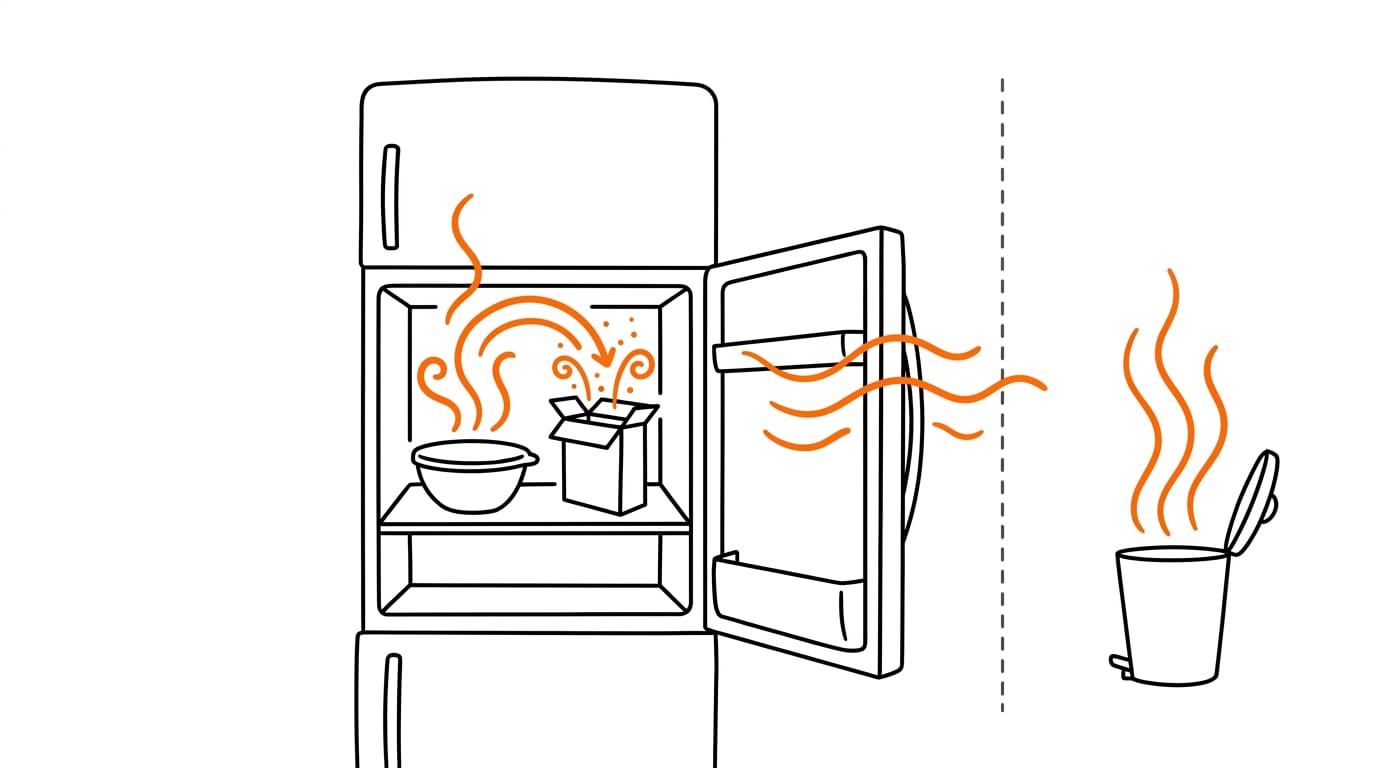
Baking soda smell removal uses exposed powder to react with some odor molecules and reduce smells, especially in small, enclosed spaces such as fridges, shoes, and cupboards. It works best after you remove the source, place enough powder where the odor is concentrated, and clean or dry affected surfaces; it cannot reach deep contamination or keep up with smells in large, ventilated rooms. If an odor returns, find and fix its source rather than covering it with more powder or fragrance.
Think of the kitchen bin on a warm afternoon, or the gym bag left in the hallway all week. That sour smell seems to take over the whole room.
Baking soda, the plain white powder in your cupboard, is a surprisingly handy odor fighter. It works best when you know both how it helps and where it stops, since it can’t remove what’s causing the smell.
Here’s what we’ll cover: how baking soda works, where it falls short, and cupboard-first fixes that tackle the source.
How Baking Soda Smell Removal Actually Works
Baking soda, known in the UK as bicarbonate of soda, doesn’t just cover a smell. Knowing what happens inside that open box tells you exactly where it’s worth using.
The chemistry behind neutralizing odors
Odor molecules can be acidic or basic. Baking soda is a base, so its particles can react with acidic odor molecules in the air.
A study on urine-separated toilet systems puts it this way: “Baking Soda deodorizes by bringing both acidic and basic odor molecules into a neutral, more odor-free state.”
This is an acid-base reaction, the meeting of an acid and a base, and it changes the molecules rather than covering them up.
Neutralization happens in the air. The particles don’t need to touch the source itself; they work on odor molecules as those molecules drift past. The smell lives in the air, so that’s where the work happens.
How it soaks up airborne moisture
Baking soda also attracts airborne moisture. Leave an open bowl in a humid spot and you’ll see it start to clump. Those clumps show the powder reacting to humidity, not odor. Lumps mean moisture, not success.
Where it works best
Baking soda earns its keep in small, closed-off spaces, where odors are concentrated. According to the School of Chemistry & Biochemistry, it’s commonly used to reduce odors in enclosed spaces such as refrigerators and shoes.
Think of a parent who opens the fridge to a sour smell from a forgotten carton of milk. A box on the middle shelf tackles that smell where it’s concentrated, so the fridge smells fresh again before the school run.
The same trick works in the shoe cabinet by the front door.
Ways to Use Baking Soda Well
Baking soda can only absorb odors it reaches, so placement and upkeep matter. Here’s how to get the most from it.
Where to place it in your fridge
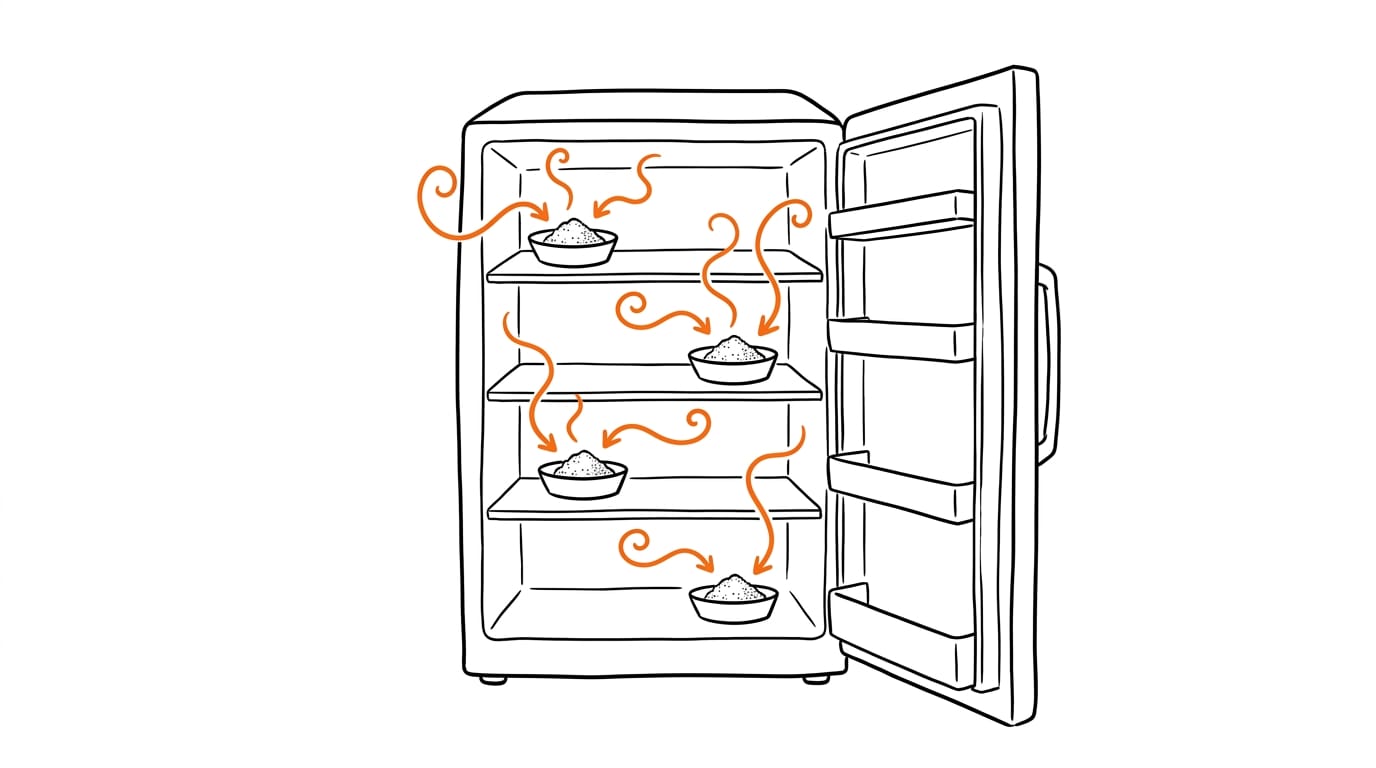
Think of a flatmate whose fridge still smells sour after the milk is gone. Two open dishes on different shelves give the powder room to work.
- Clear spoiled food first. Bin anything past its best, since the powder can’t do that job.
- Open or vent the box. Pull off the lid or poke a few holes so the powder is exposed.
- Mesh-covered fridge panels. Keep your dish clear of any mesh so you don’t block it.
- Small containers on every shelf. Spread several small dishes across the shelves rather than stacking one box in a corner.
- More surface area works faster. Ek, one of three pro cleaners says the more powder you expose, the faster it works.
How often to swap it out
Baking soda keeps working as long as any powder remains, so skip the calendar. Powder left? Keep it going.
Instead of buying a fresh box every month, try a refillable dispenser and refill it as the powder runs low.
Using it on carpets and shoes
Wondering if baking powder can stand in? It isn’t the same product as baking soda, so check the label before you swap one for the other.
- Carpets, shoes, and enclosed spaces. Sprinkle it on carpets, inside shoes, and in closed spaces like a shoe cupboard.
- Washable or vacuumable surfaces. Use it only where you can vacuum or wash afterward.
- An open bowl in a bedroom. Set out an open bowl rather than a sealed pack. If you’re pregnant, check with your doctor or midwife first, since they can advise whether baking soda suits your situation.
When Baking Soda Falls Short
Baking soda is a handy first step, but it has limits. It tends to fall short in two situations:
Why it struggles in large rooms
Baking soda works best when the odor is concentrated in a small space. In a big room, the smell spreads thin, so a single open box has far less to grab onto. You might leave one out overnight and see no noticeable change by morning.
Moving air makes it worse, too. Fans and heating vents carry odor past the powder before it has time to work.
Does baking soda absorb paint fumes? Not enough to clear the room. A box on the windowsill can take in a little odor at the surface, but a freshly painted room releases far more than a box can keep up with.
Open windows and fresh air do the heavy lifting here.
Smells coming from a deeper source
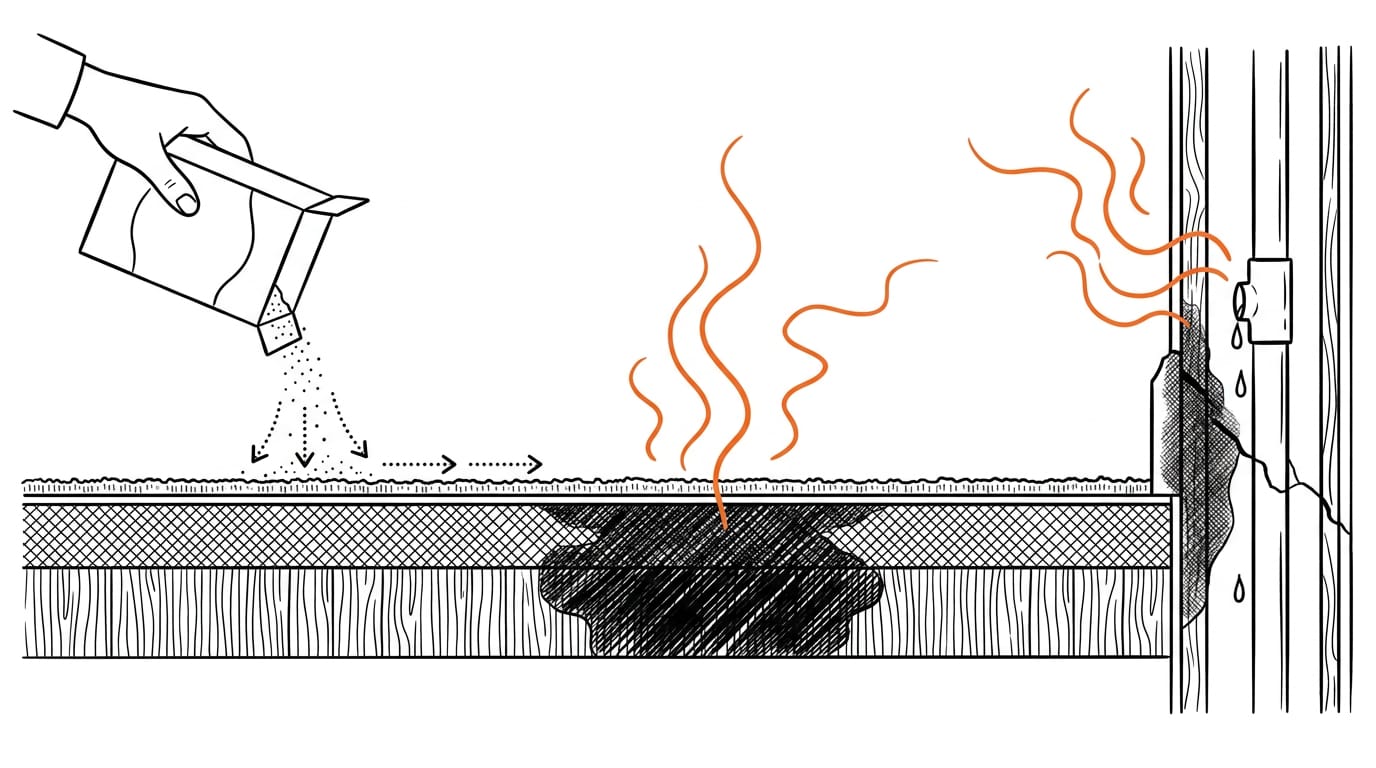
Baking soda works on the surface, not the source. If the smell lives inside a material or behind a wall, a sprinkle on top won’t reach it. Watch for these cases:
- Deep contamination. When the odor is embedded in the material, a surface box never gets to the root.
- Pet urine in carpet padding. Urine can soak through the carpet into the padding underneath, where the box never touches it.
- Moisture behind walls. Damp or plumbing problems keep the smell alive. Picture a tenant sprinkling a box in the hallway for a week while a damp patch behind the wall keeps the smell coming back. Once the damp is traced and fixed, the smell has nothing to feed on.
- Porous materials. These soak up odor and hold on to it, so a surface treatment rarely gets to the core.
Find the source first, then reach for the box.
Tracking Down Where the Smell Starts
Baking soda only works on a smell you’ve actually located. Find the source first, then clear it in the right order.
Figure out what’s causing the smell
Match the smell to its likely cause:
- Musty: damp material or mildew.
- Ammonia: urine, often from a pet.
- Smoky: residue soaked into porous materials like upholstery.
- Sewer: a dry drain trap (the curved pipe under a sink) or a clog.
Then check hidden spots: under the sink, behind the bin, and inside appliances like the washing machine door seal.
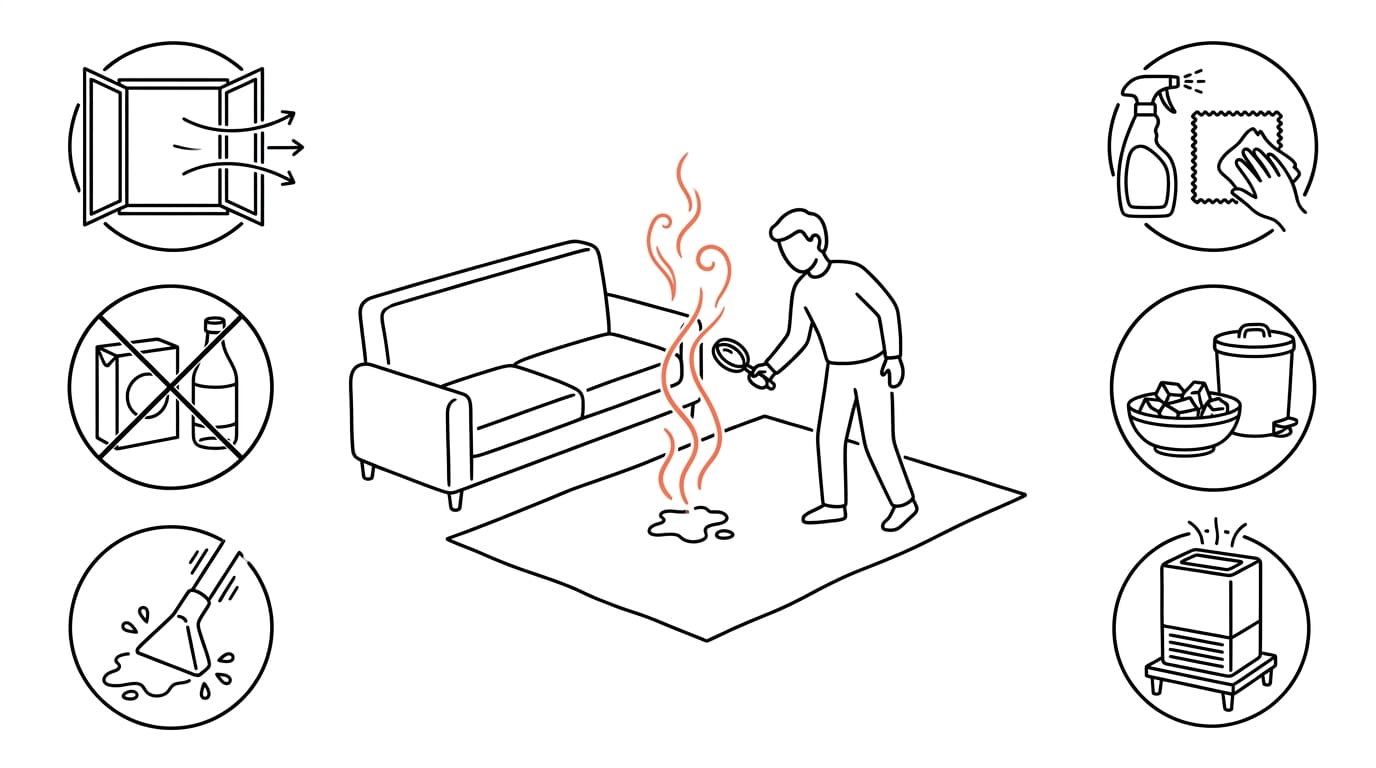
Clearing a smell step by step
Work through these in order:
- Remove the source first. Bin the rubbish and pull out anything soaked. Baking soda can’t beat something still rotting.
- Ventilate the room. Open windows and run a fan while you clean.
- Clean hard and soft surfaces. Wipe hard surfaces with washing-up liquid. Vacuum soft ones, sprinkle on baking soda, leave it, then vacuum again.
- Control moisture. Dry everything fully, since damp keeps musty smells alive.
- Reassess later. Sniff again once things are dry. If the smell’s back, the source isn’t gone.
Fixes for specific types of smells
Pet urine needs an enzymatic cleaner to break down the material causing the odor. Baking soda can only mask it.
Smoke lives in porous materials, so wash what’s washable and air out upholstery and carpet.
Cooking grease clings to the range hood, so wipe that too. Bins and washing machines need the same care: empty, scrub, and dry.
Take a flatmate who keeps catching a sour whiff from the kitchen sink. Here’s the baking soda and vinegar method: pour a handful of baking soda down the plughole, follow with a splash of white vinegar, and cover the opening so the fizz works on the gunk.
Once it stops bubbling, flush with hot water. If the smell lingers, the buildup is likely in the trap, which needs a hands-on clean. No new spray needed.
Why some smells keep coming back
Smells return when an untreated odor reservoir keeps holding them: any material that stays contaminated after the surface looks clean, like a sponge or sofa stuffing. Porous materials hold contamination deep inside, out of a wipe’s reach.
Stop adding deodorizer on top. Covering a smell isn’t the same as removing it. Air freshener masks the odor, but the reservoir keeps releasing it. Cover it, and it waits.
Other Ways to Get Rid of Odors
Baking soda isn’t the only option, and it isn’t always the right one. Here’s how the other common fixes compare:
How the other options stack up
- Ventilation. Opening a window replaces stale air with fresh air.
- White vinegar. Useful on some surfaces, not all, so check your material first.
- Activated charcoal. Absorbs odors, so you place it near the source and let it do the work.
- Carbon air purifiers. They take the same idea and put it in a machine.
- Deep carpet cleaning. Worth considering when the smell has soaked into the carpet itself, not just the surface.
- Baking soda plus vinegar. Often pitched as a smell fix, but the two cancel each other out, so use one on its own.
Can vinegar remove ammonia smell? Yes, it can help with ammonia smells, but only on surfaces that can handle it. Check a hidden spot before you treat the whole area.
Air fresheners mask smells without fixing them
Air fresheners add a scent on top of the smell rather than removing the source. Once the perfume fades, the original problem is still there.
Think of a host who sprays freshener before guests arrive while a spilled drink is still soaking into the rug. The room smells lovely for an hour, but the spill underneath hasn’t gone anywhere.
There’s a health angle too. According to the U.S. Environmental Protection Agency, products like air fresheners can release pollutants more or less continuously, so fragrance isn’t just a harmless extra. Fix the source first.
Checking Each Room and Calling for Help
Once the obvious spot is handled, walk the house to find where the smell lives. A few odors mean you should stop cleaning altogether.
What to check in each room
- Bedroom, bathroom, kitchen: check under the bed, around the bath seal, and under the sink.
- Living room, laundry room: sniff sofa cushions, rug undersides, and the washing machine seal.
- Basement or attic: look for damp patches and stored boxes, where trapped moisture builds up.
Follow the smell to where it’s strongest, not where you first noticed it. Think of a tenant whose bedroom smells stale after a rainy week. Drying the damp patch behind the wardrobe removes the cause, so the smell has nothing left to feed on.
When a smell signals something bigger
For these, the job shifts from cleaning to safety. Don’t wait.
- Gas: a rotten-egg smell means leave the house, avoid switches and flames, and call your gas supplier from outside.
- Sewer: a sewage smell often means the trap (the water-filled bend under a drain) has dried out or blocked. Run water to refill it, and call a plumber if the smell returns.
- Burning or electrical: a hot plastic smell from an outlet or appliance means unplug it if it’s safe, then get an electrician to check it.
- Significant mold, fire, or water damage: these go beyond a cupboard fix, so bring in expert help.
When to bring in a professional
- Odors keep returning: if the smell comes back after you’ve cleaned and dried the area, the source is probably still hidden.
- Smoke in porous materials: smoke soaks into carpet, upholstery, and plaster, where cleaning rarely reaches.
- Cannot locate the source: if you’ve checked every room and still can’t find it, a professional has tools you don’t have at home.
Baking soda can help with smells, but it does its best work as part of a bigger plan. Use it to soften and absorb odors, know when it won’t be enough, and go after the source first.
Work through the likely spots, from the bin and drains to the fridge and bedding, and the fix usually becomes clear. If a smell keeps coming back, that’s your sign to call in someone who can look deeper.
A smell is only a clue, so follow it to the source and your home will smell like itself again.
References
- Introduction to Indoor Air Quality — epa.gov (2026)
- How Baking Soda Actually Makes Your Fridge Smell Better — chemistry.gatech.edu
- Fate of Nitrogen in Urine Separated Toilet Systems — s-space.snu.ac.kr (2015)
- Does That Box of Baking Soda In Your Fridge Do Anything? I Asked 3 Pro Cleaners — simplyrecipes.com (2026)
Questions
What is the best natural odor eliminator for my house?
Baking soda is a useful natural odor reducer for small, enclosed spaces such as refrigerators, shoes, and cupboards. For a house-wide smell, remove the source and ventilate; an open box of baking soda is unlikely to make a noticeable difference in a large room.
How to deodorize a fridge?
Remove spoiled food and wipe the fridge clean, then place open dishes of baking soda on different shelves so more powder is exposed to the air. Keep the dishes clear of vents or mesh panels, and refill them when the powder runs low.
Why does baking soda neutralize odor?
Baking soda is a base that can react with acidic odor molecules in the air, changing them rather than simply covering their smell. It can also attract airborne moisture, which may make the powder clump.
Can baking soda be used during pregnancy?
Pregnancy alone does not necessarily make ordinary household use of baking soda unsafe, but avoid ingesting it or using it as a remedy without medical advice. For an open bowl or other use at home, ask your doctor or midwife whether it is suitable for your circumstances.
Can I use baking powder instead of baking soda for cleaning?
No. Baking powder is a different product, usually containing baking soda along with acids and starch, so it is not a direct substitute for cleaning with baking soda. Check the product label and use plain baking soda when a cleaning method calls for it.
Does baking soda absorb moisture?
Yes, baking soda attracts some airborne moisture, and it may clump in a humid place. Clumping indicates that it has taken up moisture, not that it has successfully removed an odor.
Does baking soda absorb paint fumes?
Not enough to clear paint fumes from a room. Ventilate by opening windows and bringing in fresh air, and follow the paint label’s safety directions.
Can vinegar remove ammonia smell?
Yes, vinegar can help with ammonia smells on surfaces that tolerate it. Test a hidden area first, and avoid mixing vinegar with bleach or other cleaning products.
Sources
- Fate of Nitrogen in Urine Separated Toilet Systems, s-space.snu.ac.kr,
- Introduction to Indoor Air Quality, epa.gov,
- How Baking Soda Actually Makes Your Fridge Smell Better | School of Chemistry & Biochemistry, chemistry.gatech.edu
- Does That Box of Baking Soda In Your Fridge Do Anything? I Asked 3 Pro Cleaners, simplyrecipes.com,
More in Cleaning Products
- Hydrogen Peroxide and Baking Soda: A Complete GuideHydrogen peroxide and baking soda can tackle coffee on sofa cushions. Get the simple mix, safe application steps, and when a store-bought remover is smarter.
- Mild Dish Soap for Cleaning Jewelry: A Complete GuideMild dish soap for cleaning jewelry removes lotion and grime without harsh ingredients. See the safe steps for gold, silver, and gemstones.
- Washing Soda Explained: Uses, Making It and SafetyWashing soda tackles laundry stains, household grime and workshop rust; see how it differs from baking soda and how to make it yourself safely.
Stain Finder: a free stain removal guide
Find your stain